
Sacha Rumi

Jungle Sanctuary

Sacha Rumi is an 11-hectare sanctuary of protected rainforest in the San Martín region of Peru. It is reached by a quiet footpath through the valley of San Pedro de Cumbaza. The land holds a rare combination of untouched forest, flowing water, fertile soil, and natural quiet that makes it well suited for retreats, plant diets, ceremonies, and deep inner work.

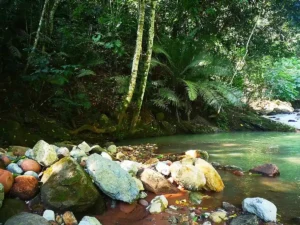
Most of the forest remains in its original state. Large canopy trees rise above a rich network of understory life where vines, roots, mosses, insects, and birds form a constant conversation. Water shapes the rhythm of the place. The Cumbaza River flows through the valley and smaller streams cross the terrain. These sources bring movement, freshness, and a sense of being held within a living ecosystem.

Sacha Rumi was created to offer a space where people can reconnect with themselves and with nature without interruption. Its solitude and natural privacy provide a container for healing work that requires depth, sincerity, and clear intention. Many visitors speak of feeling the nervous system slow soon after arriving. The land encourages a rhythm that is softer and more spacious than daily life.

In its essence, Sacha Rumi is more than a physical space. It is an environment that invites people into deeper presence. It is a place where silence becomes a companion, where water becomes a teacher, and where the forest offers a quiet reminder of how life moves when nothing is forced. Many who walk here describe a feeling that the land itself becomes part of the work. The forest meets you where you are and opens the way for what needs to be seen.
Location and Access

Sacha Rumi is located near the village of San Pedro de Cumbaza in the San Martín region of Peru. The center is about ten kilometers from the city of Tarapoto, yet it feels far removed from the pace of daily life. The journey into the land begins in the village and continues by foot along a quiet forest path. The walk takes around thirty minutes and allows visitors to arrive slowly, step by step, into the rhythm of the rainforest.

The path passes through tropical vegetation and small streams, with the sound of the Cumbaza River nearby. The river flows from the Cordillera Escalera, a protected mountain range rich in biodiversity. Its presence forms one of the natural boundaries of the land. Smaller local watercourses cross the forest and bring clear running water throughout the year.

Reaching Sacha Rumi on foot is part of the experience. The walk creates a gentle threshold between the world outside and the environment of the retreat center. Many visitors notice the shift as they enter the valley. The sounds of water and forest life replace the noise of the town, and the mind begins to settle. The land invites a different pace long before you arrive at the first structures.

Biodiversity and Ecosystem Life

Sacha Rumi sits within one of the most biodiverse regions of Peru. The land belongs to the transitional zone between the Andean foothills and the upper Amazon rainforest, an ecotone where species from both environments meet. This diversity shapes the atmosphere of the retreat center and supports the sense that the land is alive in every direction.

Flora

The forest canopy is formed by mature tropical trees that provide shade, structure, and habitat for many species. Beneath the canopy is a rich understory of broadleaf plants, ferns, vines, mosses, and small flowering species. Orchids and epiphytes grow along branches and trunks, sustained by the humidity of the valley. Medicinal plants used by local communities grow naturally in different areas of the land.

In the cultivated zones, cacao trees and fruit-bearing plants complement the native vegetation. These cultivated areas are tended with care so that they work in harmony with the surrounding forest. Together they create a landscape where wild and cultivated growth support each other and maintain the vitality of the soil.

Fauna

The surrounding region supports a wide variety of wildlife. Birds are especially abundant. Visitors often see parrots, toucans, hummingbirds, and other canopy species moving through the trees. Their calls become part of the daily soundscape of the land.

Mammals are present as well, though they are often more discreet. Monkeys such as howler and capuchin species live in nearby forests and sometimes pass through the valley. Capybaras can be found near water, and deeper in the forest it is possible to discover tracks or signs of more elusive animals.

Reptiles, amphibians, butterflies, and insects are part of the environment too. Lizards and frogs can be seen near streams and vegetation, and the forest hosts a remarkable variety of butterflies that appear with the changes of light and season. Each contributes to the ecological balance of the valley.

A Living Environment

The biodiversity of Sacha Rumi influences the atmosphere of the work done here. The presence of animals, the movement of the forest, the changing light, and the constant life in the trees create an environment that feels both vibrant and deeply calming. Many visitors describe the sense that the forest is aware of their presence and that it becomes a companion during their time on the land.

Ancient Echoes in the Stone

Just beyond the edge of Sacha Rumi, nestled in the surrounding stone, are curious depressions, ancient cupules, carved into rock perhaps thousands of years ago. Found around the world in sacred and ceremonial sites, their presence here suggests this region has long held meaning, mystery, and memory.

We don’t know who made them, or when but we honour their presence as a quiet reminder that this land was loved long before us.

Between the Rivers

Sacha Rumi lies between the Cumbaza and the Cachiyacu rivers. This position gives the land a distinct character. Water moves on both sides of the valley and creates a natural boundary that protects the forest and shapes the atmosphere of the retreat center. The presence of two rivers influences the air, the soil, the animals, and the feeling of the land itself.

The rivers help create a sense of containment. They form a quiet embrace around the property and allow visitors to feel held by the landscape. Many people describe the sensation of stepping into a clearly defined space, a place where the outside world feels more distant and where inner work becomes easier to access. The movement of water sets a rhythm that the body can feel. It brings freshness, clarity, and steadiness to the environment.

This meeting of two rivers also enriches the ecosystem. Water attracts life. Birds, insects, amphibians, and mammals gather along the edges of the rivers and streams. The moisture shapes the vegetation and supports a wide range of plants and trees. The land between two watercourses often becomes a corridor of biodiversity where species intersect and where ecological balance is especially dynamic. Sacha Rumi benefits from this natural abundance and it becomes part of the experience of those who stay here.

Spiritually, the land between rivers has long been understood as a place of passage and renewal. Water is a symbol of flow, purification, and transition. To walk into a valley held by two rivers is to enter a space that supports change. The land carries this quality. It helps people let go of what is no longer needed and invites what is ready to grow. Many visitors sense that the rivers mark a threshold into a different way of being.

In this place, the physical and the subtle meet. The rivers shape the ecology. They also shape the feeling of the land. Together they create an environment where healing work is supported by the natural world and guided by the quiet strength of flowing water.

Spaces for Inner Work

Sacha Rumi offers an environment where inner work unfolds naturally. The land holds a quiet atmosphere that supports personal retreats, plant diets, ceremonies, meditation, and somatic practices. The forest becomes part of the container and helps shape the experience of each visitor.

Several elements of the land support this work. The forest paths invite slow walking and help the mind return to the body. Open clearings provide space for movement, stretching, or silent reflection. The sound of running water is present throughout the year and creates a constant sense of grounding. Many visitors use the streams for cooling the body, for quiet moments of rest, or for simple contact with the natural world.

The natural privacy of the valley also plays an important role. The surrounding forest and terrain create a boundary that reduces outside noise and offers a feeling of protection. This helps individuals and groups settle more easily into deep processes. The land encourages a pace that is measured and attentive. It supports work that requires clarity, presence, and emotional space.

Some visitors spend time alone in nature, while others gather in shared areas for group practice. Both forms of engagement are supported by the environment. The combination of solitude, connection, silence, and natural beauty creates a balance that many people find restorative.

In this setting, inner work does not feel separate from the land. The forest, the water, the light, and the spaciousness of the valley all contribute to the process. Many people describe the sense that the land participates quietly in what unfolds. The result is a space that feels held and protected, a place where the inner world can open with trust.

The land is both sanctuary and teacher. A place where nature offers space, quiet, and presence for deep healing and renewal.